
Your Thymus Didn't Disappear After Puberty. It Just Went Quiet.
Your thymus doesn't fully shut off after puberty, it just slows down, and it's still measurably active decades later. Here's what that means for your immune resilience, and where research on thymosin alpha-1 shows the most promise.
Your Peptide Isn't Failing. Your Hormones Are.
Peptides amplify signals your body already has to be capable of producing. If your thyroid or sex hormones are underperforming, the peptide has less to work with, and the peptide usually gets blamed first.
Why BPC-157 Actually Works: The Cellular Repair Mechanism Behind the Headlines
BPC-157 has real, well-documented cellular mechanisms behind it, and a human evidence base that's still surprisingly thin. Here's what the science actually shows, mechanism by mechanism, and what one patient's experience can and can't tell us.
Peptides Aren't Magic. They're Messengers.
Peptides are everywhere right now, but most of what's marketed as a shortcut is really a signaling molecule with rules of its own. Here's what actually determines whether a peptide protocol works.
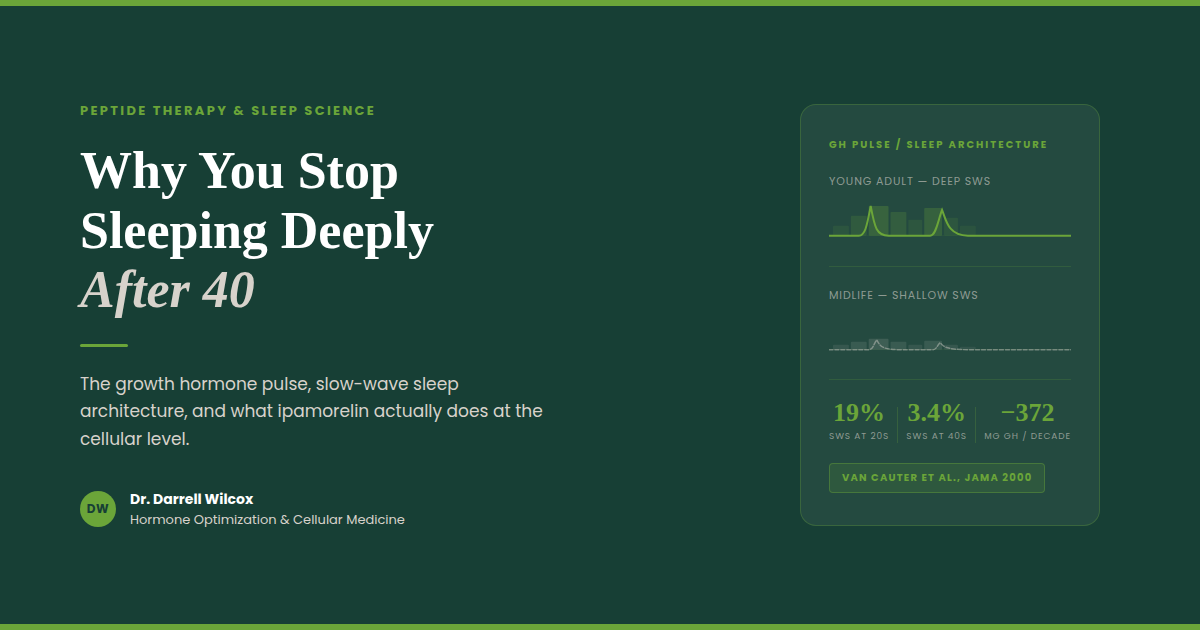
Why You Stop Sleeping Deeply After 40 — And What the Growth Hormone Pulse Has to Do With It
Your deep sleep and your growth hormone don't decline separately — they decline together. Here's the mechanism most physicians never explain, and what the data shows about restoring it.
Sermorelin vs. Ipamorelin/CJC-1295 vs. Tesamorelin: Which Growth Hormone Peptide Is Right for You?
A physician's guide to the real differences between sermorelin, ipamorelin/CJC-1295, and tesamorelin — three distinct GHRH peptides with different mechanisms, potency, and ideal use cases. Written by Darrell Wilcox, MD.